e2v_ccd97#
- optika.sensors.materials.e2v_ccd97(temperature=<Quantity 300. K>)[source]#
A model of the light-sensitive material of an e2v CCD97 sensor based on measurements by Moody et al. [2017] and Heymes et al. [2020].
This is a measurement of e2v’s “enhanced” process, which has a narrower partial charge collection region than e2v’s “standard” process.
This model uses
e2v_ccd64_thick()to represent the depletion region.- Parameters:
temperature (Quantity | AbstractScalar) – The temperature of the light-sensitive silicon substrate.
- Return type:
Examples
Plot the measured e2v CCD97 quantum efficiency vs the fitted quantum efficiency calculated using the method of Stern et al. [1994].
import matplotlib.pyplot as plt
import astropy.units as u
import astropy.visualization
import named_arrays as na
import optika

# Create a new instance of the e2v CCD97 light-sensitive material
material = optika.sensors.materials.e2v_ccd97()

# Store the wavelengths at which the QE was measured
wavelength_measured = material.eqe_measured.inputs

# Store the QE measurements
eqe_measured = material.eqe_measured.outputs

# Define a grid of wavelengths with which to evaluate the fitted QE
wavelength_fit = na.geomspace(5, 10000, axis="wavelength", num=1001) * u.AA

# Evaluate the fitted QE using the given wavelengths
eqe_fit = material.quantum_efficiency_effective(
    wavelength=wavelength_fit,
    direction=na.Cartesian3dVectorArray(0, 0, 1),
    normal=na.Cartesian3dVectorArray(0, 0, -1),
)

# Plot the measured QE vs the fitted QE
with astropy.visualization.quantity_support():
    fig, ax = plt.subplots(constrained_layout=True)
    na.plt.scatter(
        wavelength_measured,
        eqe_measured,
        label="measured",
    )
    na.plt.plot(
        wavelength_fit,
        eqe_fit,
        label="fit",
    )
    ax.set_xscale("log")
    ax.set_xlabel(f"wavelength ({wavelength_fit.unit:latex_inline})")
    ax.set_ylabel("quantum efficiency")
    ax.legend()
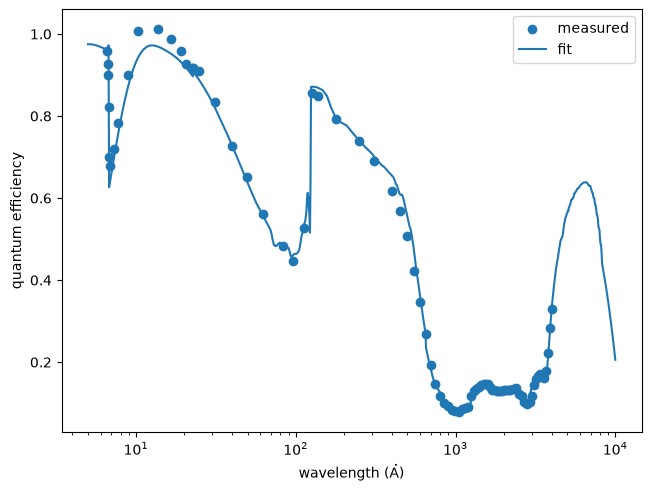
The thickness of the oxide layer found by the fit is
material.thickness_oxide
\[46.109495 \; \mathrm{\mathring{A}}\]The thickness of the implant layer found by the fit is
material.thickness_implant
\[1534.8864 \; \mathrm{\mathring{A}}\]The thickness of the substrate is
material.thickness_substrate
\[14 \; \mathrm{\mu m}\]The differential charge collection efficiency at the backsurface found by the fit is
material.cce_backsurface
\[0.33363705 \; \mathrm{}\]And the roughness of the substrate found by the fit is
material.roughness_substrate
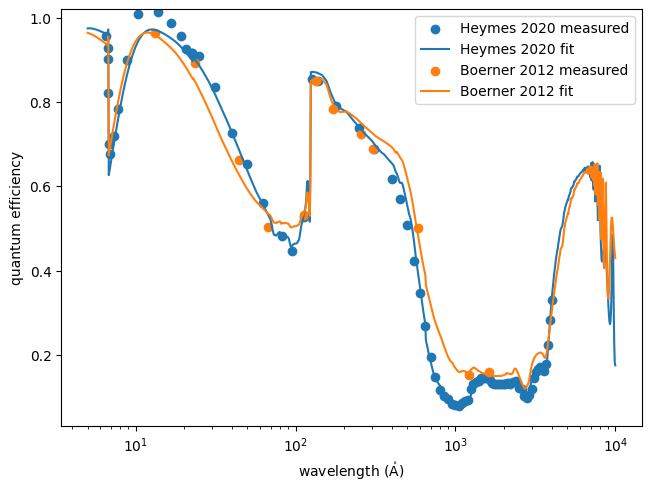
\[4.7503047 \; \mathrm{nm}\]Now plot the effective quantum efficiency of the fit to this data vs. the fit to the data in
optika.sensors.materials.e2v_ccd203()material_ccd_aia = optika.sensors.materials.e2v_ccd203() eqe_fit_aia = material_ccd_aia.quantum_efficiency_effective( wavelength=wavelength_fit, direction=na.Cartesian3dVectorArray(0, 0, 1), normal=na.Cartesian3dVectorArray(0, 0, -1), ) with astropy.visualization.quantity_support(): fig, ax = plt.subplots(constrained_layout=True) na.plt.scatter( wavelength_measured, eqe_measured, label="Heymes 2020 measured", ) na.plt.plot( wavelength_fit, eqe_fit, label="Heymes 2020 fit", ) na.plt.scatter( material_ccd_aia.eqe_measured.inputs, material_ccd_aia.eqe_measured.outputs, label="Boerner 2012 measured", ) na.plt.plot( wavelength_fit, eqe_fit_aia, label="Boerner 2012 fit", ) ax.set_xscale("log") ax.set_xlabel(f"wavelength ({wavelength_fit.unit:latex_inline})") ax.set_ylabel("quantum efficiency") ax.legend()
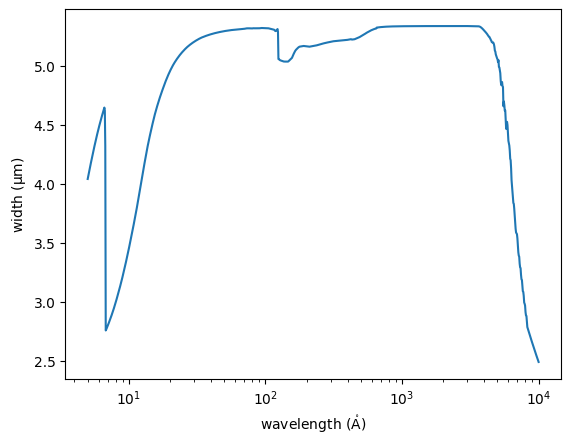
Plot the width of the charge diffusion kernel for this sensor as a function of wavelength.
# Compute the width of the charge diffusion kernel
# for each wavelength.
width = material.width_charge_diffusion(
    wavelength=wavelength_fit,
)

# Plot the results
with astropy.visualization.quantity_support():
    fig, ax = plt.subplots()
    na.plt.plot(
        wavelength_fit,
        width,
        ax=ax,
    )
    ax.set_xscale("log")
    ax.set_xlabel(f"wavelength ({ax.get_xlabel()})")
    ax.set_ylabel(f"width ({ax.get_ylabel()})")
References to
optika.sensors.materials.e2v_ccd97