AbstractInterpolatedDistortionModel#
- class optika.distortion.AbstractInterpolatedDistortionModel[source]#
Bases:
AbstractDistortionModelA distortion model defined by interpolating between known scene/sensor coordinates.
This class has two main members,
coordinates_sceneandcoordinates_sensor, the calibration points between which subclasses interpolate.Attributes
The logical axes corresponding to changing position in the scene.
The logical axis corresponding to changing wavelength.
The wavelength and position of each calibration point in the scene.
The position of each calibration point mapped onto the sensor.
Methods
__init__()distort(coordinates)Convert scene coordinates to sensor coordinates.
to_string([prefix])Public-facing version of the
__repr__method that allows for defining a prefix string, which can be used to calculate how much whitespace to add to the beginning of each line of the result.undistort(coordinates)Convert sensor coordinates to scene coordinates.
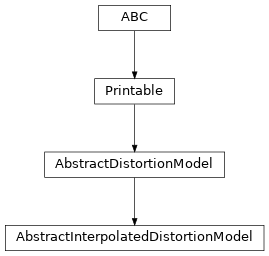
Inheritance Diagram
- abstractmethod distort(coordinates)#
Convert scene coordinates to sensor coordinates.
- Parameters:
coordinates (AbstractSpectralPositionalVectorArray) – The wavelength and position of each point in the scene.
- Return type:
- to_string(prefix=None)#
Public-facing version of the
__repr__method that allows for defining a prefix string, which can be used to calculate how much whitespace to add to the beginning of each line of the result.
- abstractmethod undistort(coordinates)#
Convert sensor coordinates to scene coordinates.
- Parameters:
coordinates (AbstractSpectralPositionalVectorArray) – The wavelength and sensor position of each point.
- Return type:
- abstract property axis_field: tuple[str, str]#
The logical axes corresponding to changing position in the scene.
- abstract property coordinates_scene: AbstractSpectralPositionalVectorArray#
The wavelength and position of each calibration point in the scene.
- abstract property coordinates_sensor: AbstractCartesian2dVectorArray#
The position of each calibration point mapped onto the sensor.