electrons_measured_approx#
- optika.sensors.electrons_measured_approx(photons_absorbed, wavelength, absorption=None, thickness_implant=<Quantity 2317. Angstrom>, thickness_substrate=<Quantity 7. um>, cce_backsurface=0.21, temperature=<Quantity 300. K>, iqy=None, fano_factor=None, shape_random=None)[source]#
A random sample from an approximate distribution of measured electrons given the number of photons absorbed by the light-sensitive layer of the sensor.
This function accounts for both Fano noise and recombination noise due to partial-charge collection.
- Parameters:
photons_absorbed (Quantity | AbstractScalar) – The number of photons absorbed by the light-sensitive layer of the sensor.
wavelength (Quantity | ScalarArray) – The vacuum wavelength of the absorbed photons.
absorption (None | Quantity | AbstractScalar) – The absorption coefficient of silicon per unit perpendicular depth. For oblique incidence, supply the effective coefficient from
optika.sensors.absorption_effective(), which folds in the refracted angle, so no separate angle argument is needed.thickness_implant (Quantity | AbstractScalar) – The thickness of the implant layer, where partial-charge collection occurs.
thickness_substrate (Quantity | AbstractScalar) – The thickness of the entire light-sensitive region of the device. The absorbed photons are distributed within this region, which sets the fraction that land in the implant layer.
cce_backsurface (Quantity | AbstractScalar) – The differential charge collection efficiency on the back surface of the sensor.
temperature (Quantity | ScalarArray) – The temperature of the silicon detector. Default is room temperature.
iqy (None | Quantity | AbstractScalar) – The ideal quantum yield of the sensor in electrons per photon. If
None(the default), the result ofquantum_yield_ideal()is used.fano_factor (None | Quantity | AbstractScalar) – The Fano factor (ratio of the variance to the mean) of the Fano noise for this sensor material in units of electrons per photon. If
None(the default), the result offano_factor()is used.shape_random (None | dict[str, int]) – Additional shape used to specify the number of samples to draw.
- Return type:
Examples
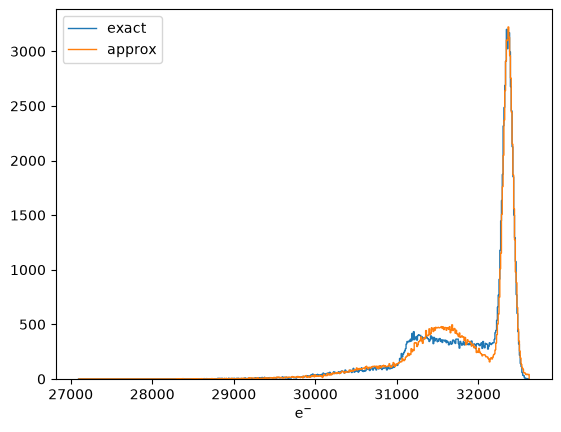
Plot the energy spectrum of twenty 6 keV photons emitted from an Fe-55 radioactive source and compare it to the exact spectrum
import matplotlib.pyplot as plt
import astropy.units as u
import astropy.visualization
import named_arrays as na
import optika

# Define the number of experiments to perform
num_experiments = 100000

# Define the expected number of photons
# for each experiment
photons_absorbed = (20 * u.photon).astype(int)

# Define the wavelength at which to sample the distribution
wavelength = 5.9 * u.keV
wavelength = wavelength.to(u.AA, equivalencies=u.spectral())

# Compute the actual number of electrons measured for each experiment
electrons_exact = optika.sensors.electrons_measured(
    photons_absorbed=photons_absorbed,
    wavelength=wavelength,
    shape_random=dict(experiment=num_experiments),
)

# Compute the approximate number of electrons measured for each experiment
electrons_approx = optika.sensors.electrons_measured_approx(
    photons_absorbed=photons_absorbed,
    wavelength=wavelength,
    shape_random=dict(experiment=num_experiments),
)

# Define the histogram bins
step = 10
bins = na.arange(
    electrons_exact.value.min()-step/2,
    electrons_exact.value.max()+step/2,
    step=step,
    axis="bin",
) * u.electron

# Compute a histogram of exact energy spectrum
hist_exact = na.histogram(
    electrons_exact,
    bins=bins,
    axis="experiment",
)

# Compute a histogram of approximate energy spectrum
hist_approx = na.histogram(
    electrons_approx,
    bins=bins,
    axis="experiment",
)

# Plot the histogram
with astropy.visualization.quantity_support():
    fig, ax = plt.subplots()
    na.plt.stairs(
        hist_exact.inputs,
        hist_exact.outputs,
        ax=ax,
        label="exact",
    );
    na.plt.stairs(
        hist_approx.inputs,
        hist_approx.outputs,
        ax=ax,
        label="approx",
    );
    ax.legend();